Tom's Blog
All Photos and Videos by Tom
THE MOVIE: WOODS OF BIWABIK
(6-minute movie follows this short read)
Me and Eddie Turk sit on a street curb half a block down from the Biwabik Mine on Minnesota’s Mesabi Iron Range. (Biiwaabik, in the Ojibwe language, means “iron” or “metal”.) The great majority of the town’s residents are immigrants or their children or, like Eddie and me, grandchildren of immigrants.
Like industrial tycoons or world diplomats, we have to sit down to create the grandest plans of the year. This is very much like the custom of the Native Peoples of our region over the centuries, but their councils often consulted on important matters like a raid or relations with other peoples seated inside a lodge or on the ground around a campfire.
Does the street-curb plan Eddie and I are making involve a raid by trespassing into the darkest backyards that night to steal crabapples and run? Or, heaven forbid, casually chat about how a kid could steal a carton of cigarettes from the Co-op Store on Main Street? Or go down the alley behind the principal’s home to their children’s playhouse just to raise the window, climb in, stack furniture against the door, climb back out, and walk away, agreeing “it was a job well done.“
No! On the curb that summer day we decided which streets we’ll hit first and second and third to get the maximum number of treats, then go home and weigh our loot. In other words, Halloween Trick or Treating! And we wouldn’t do what a neighborhood kid did: Hit the houses on our street, go home, change masks, then knock on the same doors again. We called him a “bad boy;” today it seems hilarious—a trick and a treat.
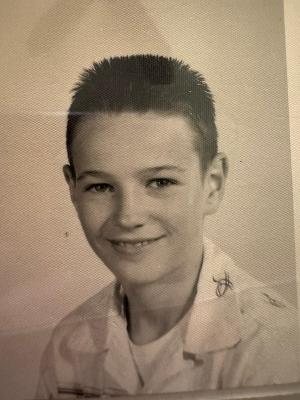
Ed Turk at about the age he and Tom sat on the curb
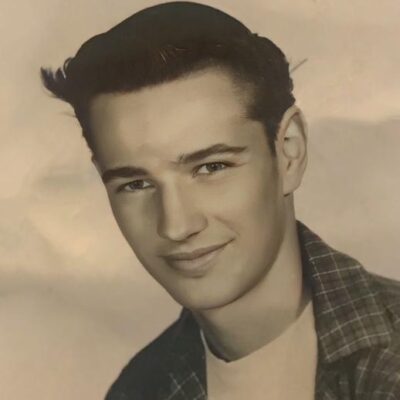
Ed in high school
A Very Big Treat
One of the biggest treats in our small universe were the woods that ran north through the historic Superior National Forest to Hudson Bay and beyond. Eddie, two years older than me, spent a lot of time in the woods and built a hunting shack deep inside with brothers Phil and Tom Sawyer.
I never helped build a shack, but some of us Boy Scouts made an overnight hike to Love’s Nest. The popularity and value of a big can of V8 juice in my backpack waxed and waned that first afternoon depending on how the prospects of getting water out of the old well grew or started to disappear.
On a frigid December day a chore assigned to classmate Don Dealing and me was to trudge up through the snow and find the perfect Christmas tree for the Community Church. As luck had it, we cut one down and dragged it back to Biwabik before freezing half to death.
The woods also challenged us in summer. A neighborhood group of us kids headed for the hills, or “the oldest mountains in the world,” my intellectual Uncle Ero informed us. We didn’t quite reach the Laurentian Continental Divide when it came time to go home. Each of us expressed a different opinion about which way Biwabik was. We settled on my sister Mary’s hunch—it’s good to listen to older sisters, isn’t it!
And in those woods one November morning I fired the 8 mm World War II German Mauser my Uncle Ernie had taken home from the war. He gave it to me when I was old enough to hunt. When I walked up to the spot I’d fired at, I found my deer dead on the ground. (I still have the Mauser but this year I’ll give it to 14-year-old Nick, a great-grandnephew of Ernie; Nick doesn’t know yet).
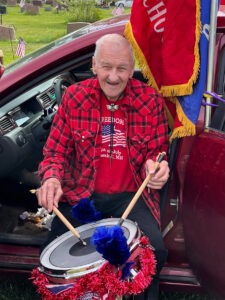
Bob Karish, Memorial Day 2023
Pack of Wolves
Today, Bob Karish will describe Love’s Nest in the Biwabik woods as his clan’s hunting shack, pointing out he’s been up there hundreds of times.
And Gary Valimaki enthralls us about his life in the woods in the 1950’s. He is a fountain of many stories. Here’s one.
“I’d get home from school. Right inside the door I’d find my .30-30 rifle, ammunition, and a full backpack that my mother arranged. She knew I was going to the Sherek shack that day.”
“I skirted around the deep Biwabik mine pit. With gun, ammo and pack I walked north for an hour and a half. The sky and trail turned dark on my way up. I knew every step of the way so didn’t use a flashlight. A pack of wolves followed me every time. They howled every night while I was in bed.”
“Some of us did a lot of deer hunting up there,” Gary tells us. “Four could sleep in the bunkbed, but it was crowded. We always got deer. We cut them up and carried them home in our backpacks.”
Starting at age 14, Gary was in his glory, it seems to me, a teenager often alone in the deep wilderness with thousands of nature’s plants and animals. Gary later served his country for 20 years in the United States Army, completing his service as a Major. He later worked at the Lake Mine, a/k/a Wacootah Mine. The water’s depth in the pit is now 460 feet.

Gary Valimaki has stories to tell!
My childhood friend Ed Turk and I reminisced about the Biwabik woods a few years ago. He pointed out on my USDA Forest Service map the spot of the log hunting shack he and the Sawyer boys built.
“I really have to go search for the location of that shack, even though it’s long gone,” I told myself and then Eddie.
Here’s the video. I was likely on the trail that Ed, Gary and Bob traveled, seldom ever meeting anyone else. When I was just out of high school, I interviewed the elderly Bill Larson of Biwabik. Bill said the Ojibwe people traveled through those woods for miles carrying their canoes, gear and trade goods. They were portaging between the south-flowing chain of lakes and streams east of Biwabik and the north-flowing Pike River and on to Lake Vermilion—with its 365 islands and a thousand miles of shoreline.
The portaging Ojibwe and we Biwabikans crossed the Laurentian Continental Divide, which runs 2,500 miles from Glacier Park to Labrador. The Ojibwe had established a presence in the Biwabik region just before the American Revolutionary War.
Play The Movie: Woods of Biwabik
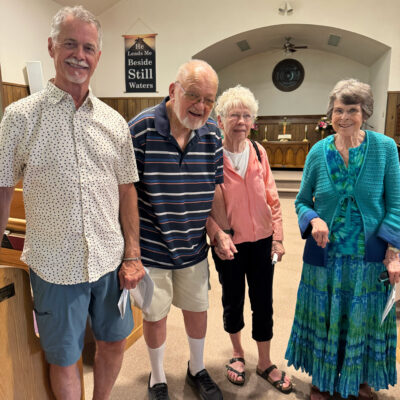
In their childhoods, Nick, Gary, Peggy and Carol played or hiked in the Woods of Biwabik.
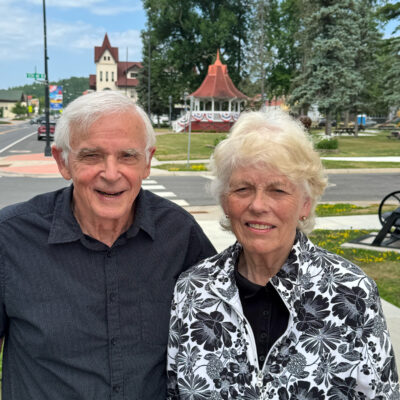
Ron and Betty traveled in the woods years before they were married.
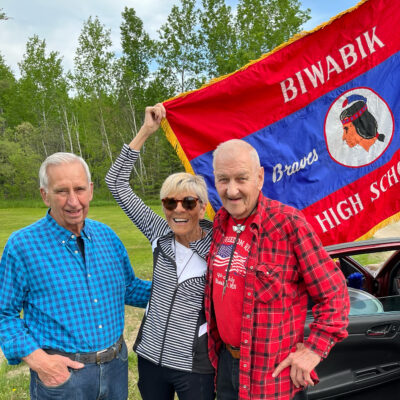
Bob Karish with Biwabik friends Doc and Carol.

Ed Turk with granddaughter Veda.
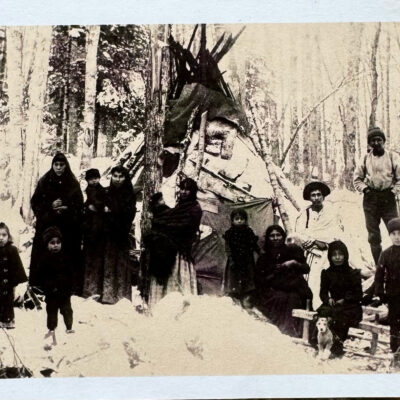
An Ojibwe community near the shore of Lake Esquagama, four miles from Biwabik, a century or more ago. (Photo courtesy of the Iron Range Historical Society.)
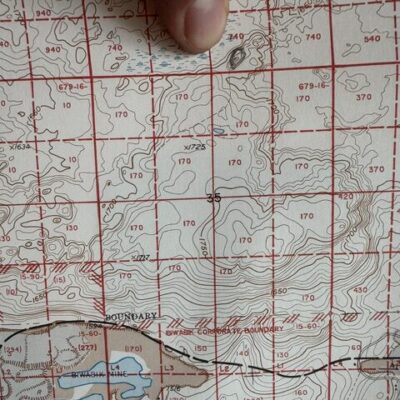
Ed Turk circled the spot in the Superior National Forest where he and the Sawyer boys built a hunting shack. Tom searched for it in The Movie: Woods of Biwabik, and he phoned Ed from deep in forest.